
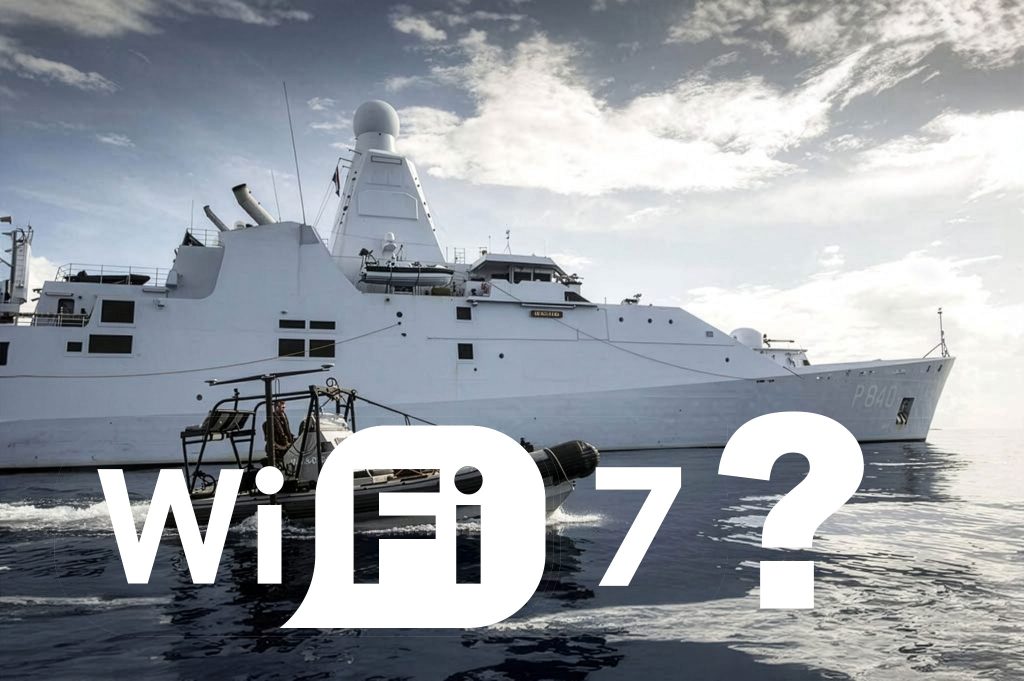
We usually stick to proven technology. But for new builds, the rules are different.
At The IP Company, we have a simple rule: We don’t beta test on the ocean.
Our reputation is built on delivering proven, rock-solid technology. When a crew member presses the “Talk” button on their communicator, it has to work. This is why we often prioritize stable, established technology over the “latest and greatest” gadget you might see in a consumer electronics store.
However, the maritime industry has a unique challenge: Time.
A vessel designed today often won’t leave the shipyard for another three years. If we design a ship in 2026 using “current” technology, it will launch in 2029 with “old” technology.
This brings us to Wi-Fi 7. While it might seem too new for some, it is the exact right standard for the ships of tomorrow. Here is the honest truth about what Wi-Fi 7 offers the maritime world and what it doesn’t.
The “Consumer” Hype vs. The Maritime Reality
If you read the marketing brochures for Wi-Fi 7, you see big numbers: “320 MHz channels” and “40 Gbps speeds.”
Let’s be clear: We won’t see those theoretical numbers on a ship.
- Speed vs. Space: In the US, there is plenty of radio space (spectrum). In Europe and on the tight confines of a steel ship, radio space is limited. We can’t use those massive “320 MHz” super-lanes without causing interference. We stick to narrower, stable lanes to ensure every Access Point plays nicely with its neighbor.
- The “4K QAM” Bonus: Marketing says this feature is for speed. In reality, it requires a perfect signal something hard to find inside a metal hull. But there is a hidden benefit. To support this feature, the chips in Wi-Fi 7 Access Points are built with better “ears” (higher sensitivity). Even if we don’t use the top speed, these sensitive radios are better at “hearing” your crew’s devices in difficult corners of the ship. That reliability is worth the upgrade alone.
- The “Weakest Link” Reality: Be aware that marketing headlines often quote speeds based on 8 or 16 antennas (MIMO). In the real world, speed is defined by the weakest link: the phone in your hand. Most rugged maritime clients use only 2 antennas (2×2 MIMO). We design for the real-world performance of your devices, not the theoretical maximums of the router.
The Real Killer Features: Latency & Efficiency
For us, Wi-Fi 7 isn’t about downloading movies faster. It’s about Voice Quality and Network Efficiency. Two features make this a game-changer for our Wireless Communication & Messaging System (WCMS).
MLO & EMLSR: The “Smart Switch” for Latency
In previous Wi-Fi generations, a phone had to commit to one frequency (e.g., 5 GHz). If that band got crowded, the audio would stutter.
Wi-Fi 7 introduces Multi-Link Operation (MLO). However, we need to be realistic about what this means for handheld devices.
- The “Dream” (Full MLO): Ideally, MLO allows a device to send data on multiple bands (e.g., 5 GHz + 6 GHz) simultaneously. This creates massive redundancy. However, this requires complex, power-hungry radios that are unlikely to appear in standard handhelds anytime soon.
- The Reality (EMLSR): The most likely standard for maritime handsets is Enhanced Multi-Link Single Radio (EMLSR).
How EMLSR works on your ship: Imagine a modern rugged smartphone with two antennas (2×2 MIMO). With EMLSR, it can virtually split its radio. It uses one antenna to actively transmit data (1×1) while the second antenna acts as a scout, simultaneously scanning the other band.
- The Benefit: The device constantly compares error rates and retries between bands. It isn’t looking for better coverage (it won’t fix a dead zone), but it is looking for lower delay.
- The Fix: If the “scout” detects that the current band has high latency (jitter), the phone can instantly switch transmission to the cleaner band. This ensures that voice packets always take the fastest path, keeping communication crisp even in a busy electronic environment.
MRU: The “Traffic Cop”
Standard Wi-Fi is inefficient; if a large data packet is sent, it can sometimes block the “road” for everyone else.
- The MRU Fix: Multiple Resource Units (MRU) allow the network to be far more efficient with how it packs data. Think of it as “filling the gaps.” If a large download is happening, MRU allows that data to utilize fragmented, non-contiguous parts of the spectrum.
- The Benefit: By packing the “background noise” of data traffic more efficiently, the main highway remains less congested. While voice traffic already has priority, MRU ensures that other systems on the ship don’t clog the airwaves, maintaining overall network health.
The “Chicken and Egg” Problem (And Why the Timeline Matters)
So, if Wi-Fi 7 is so great, why aren’t we installing it on every ship right now?
The answer lies in your pocket. A Wi-Fi network is a conversation between two devices: the Access Point (the antenna) and the Client (the smartphone). To get the benefits of MLO or MRU, both must speak the language of Wi-Fi 7.
Right now, consumer phones (like the latest high-end smartphones) support Wi-Fi 7. But the ruggedized, industrial handsets used by maritime crews are often a generation behind. They prioritize battery life and durability over the newest chips.
If we installed a Wi-Fi 7 network on an active ship today, the current rugged phones wouldn’t be able to use the new features immediately. However, the infrastructure would be ready the moment you upgrade your handsets.
Our Strategy: The 3-Year Horizon
This is where the shipbuilding timeline works in our favor.
- For Retrofits (Today): We can deploy Wi-Fi 7 immediately. Even if your current handsets are Wi-Fi 6, installing Wi-Fi 7 infrastructure now creates a future-proof backbone. It ensures that as you replace devices over the next decade, the network is already waiting to unlock their full potential.
- For New Builds (2029 Launch): If we are designing a vessel today that will launch in 3 years, we specify Wi-Fi 7 infrastructure. By the time the ship leaves the yard, the next generation of rugged handsets will be ready.
Conclusion
We don’t chase trends; we chase reliability.
For ships launching in the future, Wi-Fi 7 offers a smarter, more sensitive, and more efficient network. By aligning the network design with the ship’s delivery date, we ensure that on Day 1, your vessel is ready for the future. Not stuck in the past.